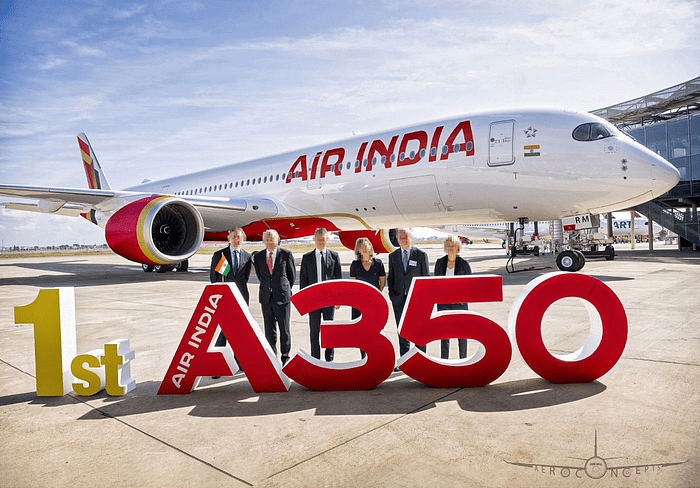
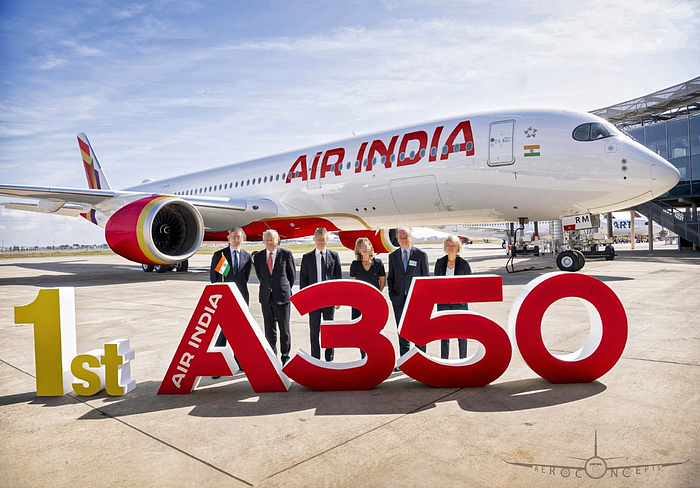
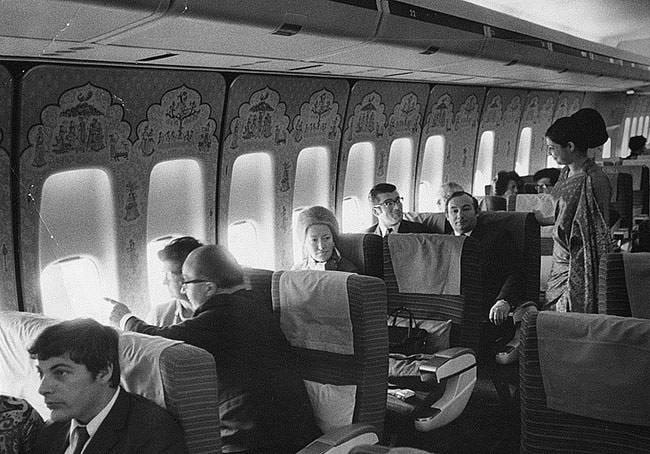
The Indian flag carrier since its re-acquisition from Tata in 2022 has been having a renaissance of sorts, with the Tata group trying to revive the glory the airline once had. Air India in its early days was known for being a luxury airline with high-quality service that impressed many, including a young Tim Clark, who would one day become the CEO of Emirates, an airline that is known for defining what luxury in the sky. While the airline had this great lagacy in it’s early days, it soon became something of the past, with the airline being nationalized in 1953 under the rule of the prime minister Indra Gandhi, where it saw it’s slow downfall, becoming a debt ridden airline for many years, until finally, the decision was made by the Indian government, under current prime minister Narendra Modi to privatize the airline, upon which the founding group of the airline, the Tata Conglomorate re-acquired the airline.
Upon aquisition of the airline, the Tata group has been fast to push the airline to become the world renowned airline it once was, making history in 2023 with the largest aircraft order in the history of aviation, and being ambitious with a plan to compete with middle eastern giants like Emirates and Qatar Airways on transporting passengers to and from India. With a financially prospurous Indian diaspora in many countrys like the United States, United Kingdom, and Australia who are eager to travel back home for business or visitng family, Air India sees a golden market capitalize on. And with current Indian laws becoming more and more supportive of the airline industry and the Indian aviation market being the fastest growing currently, it is of no doubt that Air India is commited to their plan to once again become a world class airline, something that requieres maticulous strategic thought.
The Strategic Gold Mine Of The Hub and Spoke Model In The Middle East
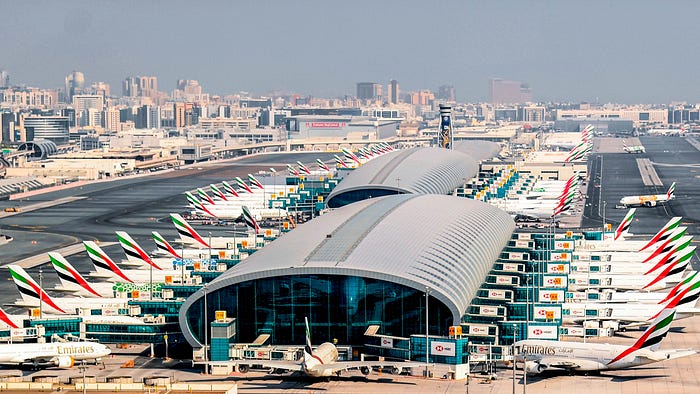
In order to better understand where Air India strategicall stands in the international market, it is important to understand how much Emirates and Qatar Airways rely on using the hub and spoke model, something that Air India is not necessarilly cut out for using. Emirates, the most profitable of airline is known for flying people around the world, using Dubai as a one stop hub, where people can connect to their destination, something that allows Emirates to dominate global travel. Emirates makes it so that people can fly directly from a mid-sized US city like Columbus in Ohio to a mid sized city in India, like Vishakapatnam, only with one stop in Dubai. Throughout the journey, the passengers does not need to worry about taking care of checked bags or immigration, as their bags are directly checked to their destination, and they simply need to wait in the Dubai airport for their next flight.
Dubai and Doha are geopgraphically located in a perfect place, where you can fly nonstop to almost any part of the world, with only one stop, something that is effectiant for both customers and the back end oeprations of an airline. Airlines can focus all of their money into building up one hub location where they can take care of maintaining aicrafts and building the airport terminal for ultimate pasenger comfort. We see airports in Doha, Singapore, Munich, Dubai, Hong Kong, and many other connection hubs of airlines around the world are known to be large and full of passenger amenities, like the movie theatre in Singapore Changi Airport and the gym in Munich International Airport. All of these are amenities to further improve passenger experience, allowing them to relax in between flights.
Meanwhile, these airports cities house the majority of the airlines staff, be it airport workers, maintainence professionals, pilots, and flight attendtants. These airlines have most of their operations in and out of one place, so it is easy for them to double down on one city, making it possible to have high quality infrastructure, instead of their being a higher quantity of places with infrastructure. Something that Air India can’t do, and neither can the United States airlines.
The Success of United States Airlines
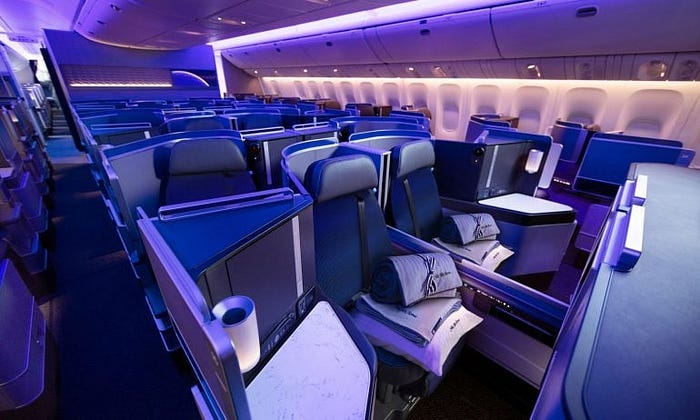
While the majority of flights on United States airlines happen domestically, they do operate a significant number of flights internationally, taking passengers to and from the United States, similar to how Air India plans to take passangers to and from India. India historically has struggled to find success in world class international airlines, with their largest airline Indigo being a low cost airline that flys mostly domestically and makes international flights to only cities that are near India.
Meanwhile in the United States, all 3 of the major US airlines have been able to build decent international profiles. United Airlines has been able to grow a profile of 134 international destinations compared to their 238 domestic ones, American Airlines has been able to grow a profile of 130 international destinations compared to their 226 domestic ones, and Delta Airlines has been able to grow a profile of 52 international destinations compared to their 190 domestic ones. All together, these airlines do mostly have domestic destinations, but have been able to grow a significant amount within the international market. These airlines are all profitable, and Ameircan Airlinas as of today is the highest valued airline in the world.
The reason these airlines have a profitable international market while having atleast 3 hubs each across the country is because of their decision to focus on either offering nonstop flights on international routes with high volumes or from their hubs to the hubs of their code share partners. Every single one of these airlines is in a major allience and sells tickets for flights on other airlines across the world. United Airlines is a part of star allience, American is a part of One World, and Delta is part of Sky Team. United Airlines focuses on partnership with Lufthansa, ANA, Air Newzealand, many more airlines in order to be able to hold a stronger international profile, something that Air India should focus more on, with their being a part of the Star Allience, the same alliance as United.
On top of this, while airlines like Emirates don’t really have many smaller aircrafts using the A380 and 777–300ER for their international operations, US airlines focus on using smaller aircrafts. American for example uses the 787–9 for most of their routes and the 777 for only some of their more high in demand routes, something that Air India should focus on. Furthermore, when being a nonstop flight airline in the international market, you can’t directly go top war with the hub and spoke airlines, and should rather become a jack of all trades, flying to either destinations where you can sell tickets on other airlines flights, or finding popular routes booked on hub and spoke carriers and offering nonmstop competitors to their on smaller aircrafts like the 787’s.
Understanding How Air India Can Implement This
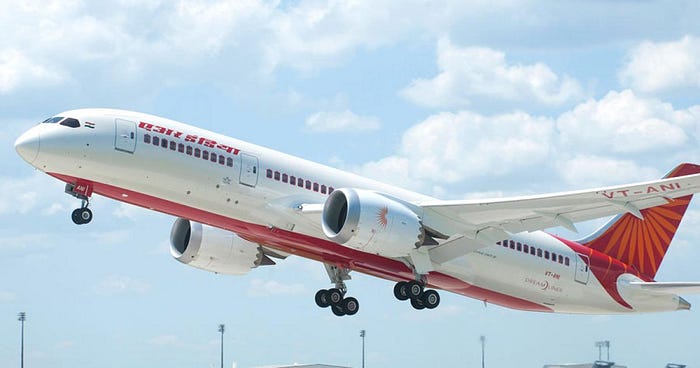
Furthermore, Air India is an airline must focus on building themselves up as an Indian airline, focusing on delivering service that represents Indian hospitality, and designing their product to also represent India culturally. Becoming a hub and spoke airline is something that Air India is not cut out to do, as currently Indian airports are already clogged with domestic traffic. Emirates will always dominate traffic from midsize the US and other Western cities to mid-sized Indian cities, and even have an edge on most of the international traffic to India, as their hub and spoke model is very easy to operate. Let’s say hypothetically you were flying on Air India, and trying to go from Phoenix, Arizona to Hyderabad India, a route that’s not popular enough to have it at its own flight, but something that when booked on Air India would require the need to fly from Phoenix to San Francisco, connect in San Francisco and board a flight to Delhi, from where you would arrive, have to do immigration and take out your checked in bags, and check them into a flight to Hyderabad. Meanwhile, if you’re flying an Emirates, you would simply need to fly from Phoenix to Dubai and then seamlessly connect onto another flight from Dubai to Hyderabad, after which you would do immigration and pick up your checked in bags in Hyderabad. Furthermore, Air India will not be able to compete with the convenience of Emirates on this route.
Meanwhile, Air India could be able to build a brand of offering non-stop routes on flights that have enough demand to be operated on a smaller wide-body aircraft like the 787, but not on larger wide body aircrafts like the A350–1000. Airline has currently ordered a fleet of 70 widebody aircrafts that are likely intended for international use, with 40 of these aircrafts being a350s and 30 of them being from Boeing, with 20 787–9s and 10 777x aircrafts. Out of these aircrafts, I feel like the airline would benefit if they were to order more of the 900 variant on the a350, rather than having the same number of aircrafts for the 1000 and 900 variant. Airlines should be utilizing their 787 fleet for long-haul flights, and focus on retrofitting them to offer competitive cabins when planning to expand routes to the United States, Australia, and maybe even New Zealand. They should consider not using their 787 on many of their regional routes to Asia, replacing them with some of their a321 aircrafts or 737 aircrafts. They could even be using narrow body aircraft on some of their flights to Europe. Many airlines like Fly Dubai and American have retrofitted their narrow body aircraft to offer things like lie, flat beds and direct aisle access in business class. Air India should look into the option of having multiple configurations for their narrow body aircraft, but some being configured for shorter international flights and others being configured for domestic flights.
With the availability of more 787 aircraft, Air India could focus on using their larger widebody aircraft for expanding flights that already are pretty high in demand, like their flights to San Francisco and New York. With their smaller wide body aircraft like the 787 and 900 variant A350s they can focus on popular routes booked on Emirates and Qatar Airways between American and Indian cities. India is a very ethnically, diverse country, and therefore many Indians from certain regions are likely to immigrate to other cities in the United States and other Western countries. Examples of routes that could be fulfilled with the 787 include flights from New York to smaller Indian cities like Hyderabad, Bangalore, Ahmedabad, and more, as the greater New York area does have large populations of people from many parts of India. A potential route that could be very successful would be one from Ahmedabad to Newark, as the small city of Edison in New Jersey has a large population of people from the Indian state of Gujarat that the root could be sold to, on top of which Newark is a hub for United Airlines, allowing the opportunity to sell tickets on code share connecting flights from the Indian state of Gujarat to most of the United States. These routes could be offered with the convenience of being able to check in only once, as somebody could be booking a ticket from a city that Air India flies to from Delhi or Mumbai. Let’s say hypothetically somebody wants to book a ticket from Washington, DC to Ahmedabad. The perfect way to book the flight on Air India is to have people on the way up the fly United from Washington DC to Newark after which they would be able to fly Air India to Ahmedabad, having them check in only in Washington, DC. On their way back they could fly via New Delhi, as there’s a non-stop light to Washington, DC from New Delhi. This would in turn maximize passenger convenience, allowing for the profitability and success of this route. The 787–8 fleet of Air India currently consists of aircrafts that aren’t even competitive for the mid-range flights they’re used for, and should be retrofitted to support long-haul flights. They should offer a cabin similar to what Vistara currently has on their 787–9 fleet, a fleet of aircraft that Air India will get as a part of their merger was Vistara. Upon the merger, the 787 fleet of Vistara should be repurposed to be used for ultra long-haul flights on Air India that don’t have enough demand to be operated with the A350 or 777.
Air India needs to know what game they’re playing, and understand the strategic advantages and disadvantages that they have. They should focus on offering non-stop routes and improving code share partnerships within the Star Alliance, as it’s essential for their growth. They don’t have the hub and spoke model advantage that Emirates has, through which they don’t even need code share partnerships. Instead, they should follow the strategy of United States Airlines, as India is a large country with many large citys, similar to the United States. If played properly, Air India could be able to dominate the skys and become a world class airline, using the economic growth of India and nonstop connectivity to their advantage.
 The Sky Wire